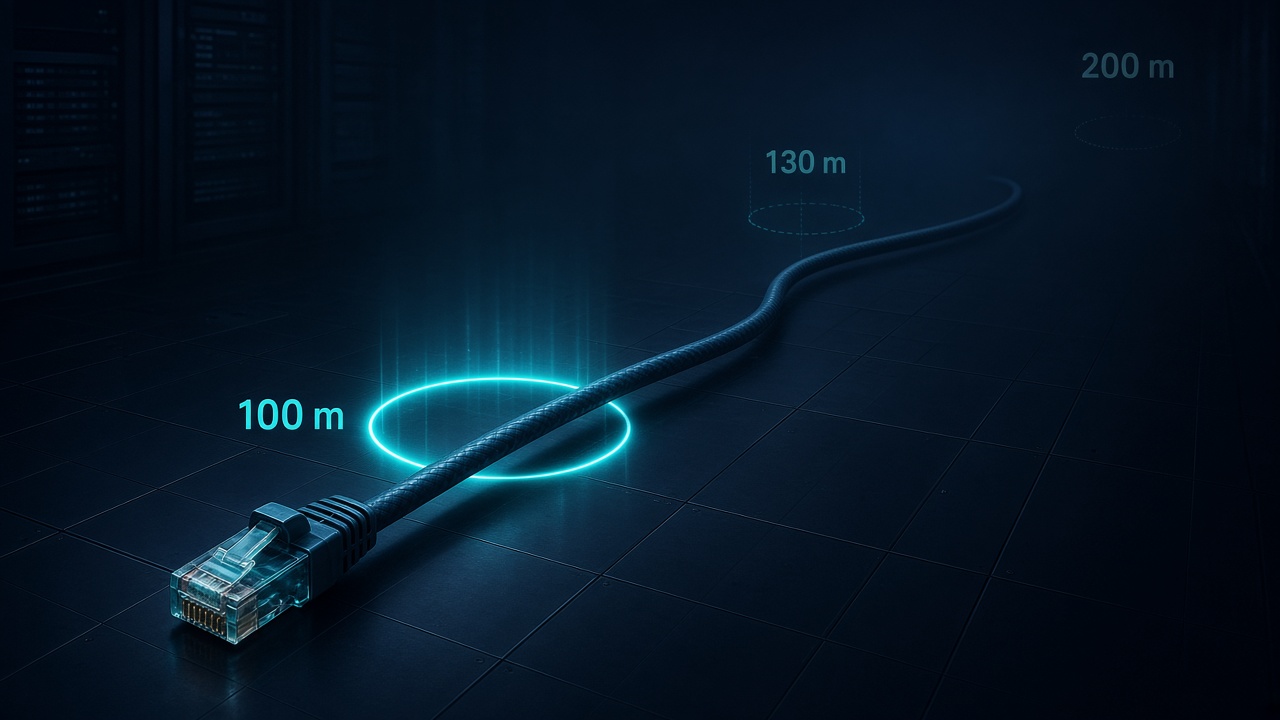
Every network person learns the rule early: copper Ethernet stops at 100 meters. It's on every spec sheet, in every cabling standard, and it's the first thing anyone tells you when you suggest "just running a longer cable."
I've always been interested in the documented limits and where they come from, but I've never actually pushed past them myself. When a client's uptime is on the line, you don't experiment with their network. You follow the standard and you run fiber when the distance calls for it.
So I was glad to see that someone did the experiment for me.
The Experiment
John Huntington at ControlGeek took a brand-new 1,000-foot box of Cat 5e and set out to find where it actually breaks. Read his full write-up here.
He started at roughly 300 meters and kept cutting the cable shorter, re-terminating it, and re-testing each time. At each length he measured a few things:
- Whether a link came up, and at what speed
- Real throughput, measured with iPerf3
- Whether PoE still powered a device
- Whether live Dante network audio played cleanly
For context, the 100-meter number comes from the TIA-568 cabling standard: a 90-meter permanent link plus 10 meters of patch cords.
What He Found
The short version is that there's more headroom than you might expect, and it runs out gradually rather than all at once.
- Beyond about 200 m: nothing worked. No link.
- Around 200 m: some devices would link, but only at 100 Mbps.
- Around 180–190 m: gigabit links started to appear, but they were unstable, and real-time audio was distorted.
- Around 130 m: everything was clean. Gigabit throughput was near line rate, and the Dante audio ran with no errors. That's roughly 30 meters (about 100 feet) past the spec.
One detail I found interesting: end devices such as a laptop, a handheld tester, and a PoE audio adapter often negotiated a link at lengths where two switches connected to each other would not. A "link up" light is not the same thing as a healthy link.
Why the Standard Still Matters
John is careful to say this is not permission to run 130-meter cables, and I agree with him. His test used one new, undamaged cable in a quiet environment with no patch panels or extra connection points. A real installation has bundled runs, interference from nearby electrical lines, older cable, several terminations, and heat. All of those use up the margin he found.
My takeaway is that the 100-meter limit isn't a cliff edge. It's a rating that includes a safety margin, and that margin is what keeps a network reliable when the cable run isn't perfect. Design to the standard and treat the extra headroom as insurance. When a run really does need to go past 100 meters, or past 1 Gbps, use fiber.
It's nice to finally see the numbers behind the rule, and I'm glad someone else cut up the cable to get them.
Source: John Huntington, "What Happens If You Send Ethernet More Than 100 Meters?", ControlGeek, November 2, 2026.
Comments